
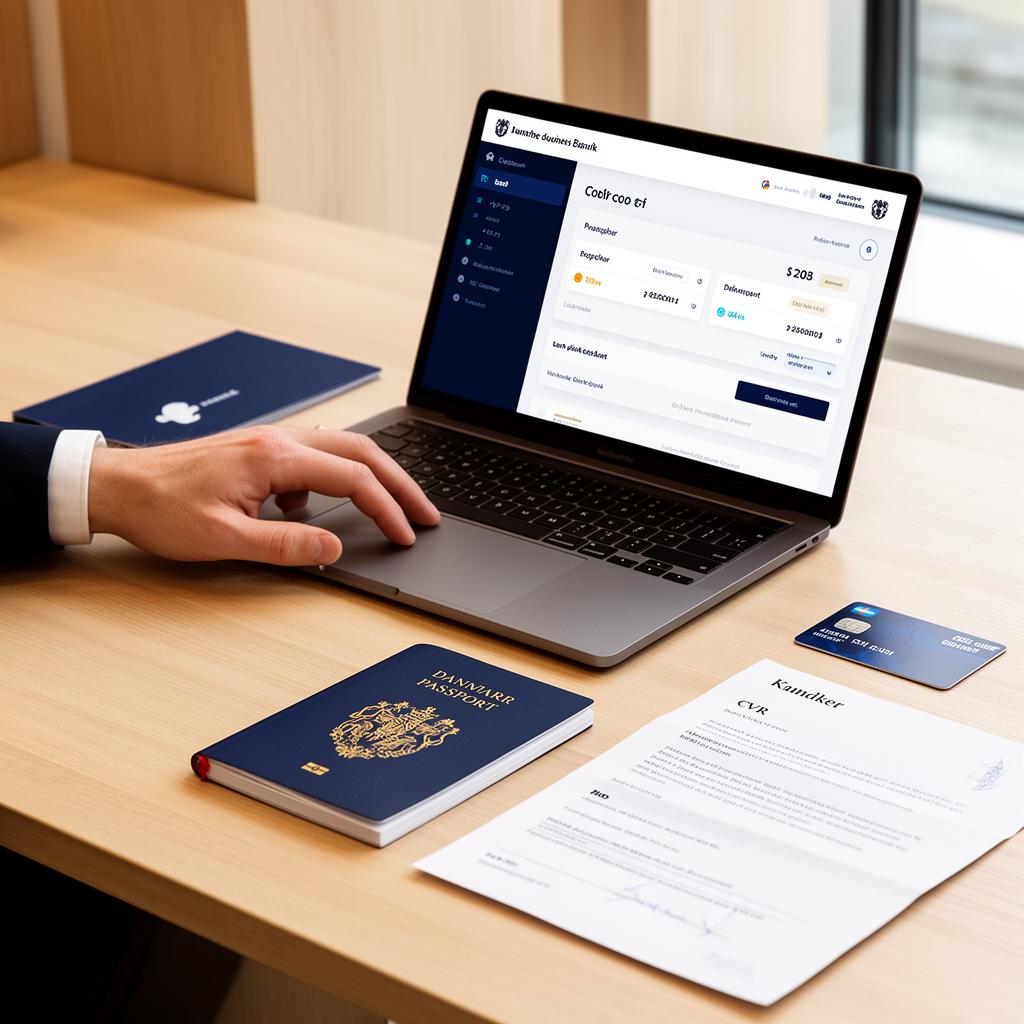
When you want to take your business seriously, it actually starts with one thing: your business account. Without it, accounting, taxes, and oversight quickly become a mess, and you might mix personal and business finances – not smart, neither for you nor for the tax authorities (SKAT). In this guide, I will go through step-by-step what you need to do, what banks look for, and how to increase your chances of a quick approval, so you can spend your time building your business instead of fighting with paperwork.
Key Takeaways:
- The first step to opening a business account is actually just getting the basics in order: a CVR number, identification, and a brief description of what your company does – the more concrete you are, the faster the conversation with the bank will go.
- The process itself is often much easier if you book a meeting online, upload documents in advance, and show up with a clear idea of your turnover, ownership, and how you plan to use the account – this way you avoid too much back and forth.
- The biggest mistake many people make is simply choosing the first bank they come across without asking about prices, fees, and terms – compare 2-3 banks, ask critical questions, and choose the one that actually suits your business, not just the one you already bank with personally.
Why You Might Need a Business Account
Is It Just for Big Businesses?
No, business accounts are not just for huge corporations with executive suites and receptionists. If you send invoices, sell via MobilePay, have a webshop, or simply receive money for your work, then you are, in practice, a business – and the bank expects a clear distinction between private and business finances. Many banks actually close personal accounts if they discover repeated business transactions, so you'll be doing both yourself and your business a favour by doing it correctly from the start.
The Perks of Having One
The biggest advantage of a business account is actually peace of mind – you always know what is your salary and what belongs to the company. At the same time, a separate account makes it much easier to document everything for SKAT, your accountant, and the bank, especially when you hit the 50,000 DKK VAT-liable turnover threshold. You also gain access to things like a business Mastercard, better credit opportunities, and sometimes discounts on payment solutions, e.g., acquiring agreements for webshops or terminals.
When I work with small self-employed individuals, I can see a difference almost from day one for those who have set up a proper business account. Accounting software (Dinero, e-conomic, Billy, etc.) can often be directly linked to the account, so all transactions automatically come in, and you avoid guesswork at year-end, when SKAT, by the way, expects you to be able to document every single penny. On the client side, it also sends a more professional signal when you issue an invoice with a CVR number and a dedicated account number, instead of the money going into a private salary account that looks like a mixed bag. And should you ever need an overdraft facility, a leasing agreement, or financing, a well-managed business account is often key to getting the bank to actually say yes.
What You Need to Get Started
Essential Documents You Can’t Forget
Over 80% of rejected business account applications are due to missing or unclear documents, so this is where you really need to be sharp. You will need valid ID (passport or driving licence), your CPR number, the company's CVR extract from virk.dk, the articles of association or bylaws, and a shareholder register if there are multiple owners. If you have a slightly more technical or scalable business, it makes sense to also include a budget, liquidity plan, and perhaps a brief description of your services – yes, even something as niche as Modular Modernization Solutions for Elevators can be good to document if that is the core of your business.
Choosing the Right Bank for You
Over 30 banks in Denmark offer business accounts, but only a handful actually suit your specific business model, so you shouldn't just pick the first one. I always look at fees, deposit requirements, response times, and how quickly you can get your account approved, because some banks still take 3-4 weeks, while others can do it in a few days. You should also check if the bank understands your industry, for example, if you work with property projects, digital products, or more technical solutions, where credit facilities and international payments may be needed from day one.
When choosing a bank, it makes sense to think further ahead than just "I just need an account now". If you expect to grow from a sole proprietorship to an ApS within 1-2 years, then choose a bank that offers both cheap accounts for small self-employed individuals and good business solutions with overdraft facilities, company cards, and integration with accounting systems like e-conomic or Dinero. Some banks, for example, have fixed packages for start-ups, where you pay a fixed monthly fee and avoid hidden costs, while others charge fees for almost everything, so there can be several thousand DKK to save annually.
You can also do something as simple as testing customer service before you decide: call 2-3 banks, briefly explain your business, and notice how quickly they understand your case, what questions they ask, and if they actually come up with concrete solutions. If they seem confused about your business model over the phone or cannot explain their own prices, there's a good chance it will be challenging later when you face currency payments, new employees, or a need for extended credit.
The Step-by-Step Process to Open Your Account
| Step | What you specifically do |
|---|---|
| 1. Choose bank and account type | You compare 2-3 banks, look at fees, initial deposit requirements (typically 0-10,000 DKK), and whether they offer business packages with cards, online banking, and possibly accounting integration. |
| 2. Complete online interest form | You fill out the bank's form with your CVR number, industry code, ownership structure, expected turnover, number of owners, and a few lines about how you practically earn money. |
| 3. Upload documents | You upload ID, company documents, shareholder register, and possibly a business plan; the bank uses all of this for their KYC and anti-money laundering checks, which they are legally mandated to conduct. |
| 4. Risk assessment | The bank performs an internal assessment of your industry, payment flows, and countries you trade with; high-risk areas (crypto, gambling, exports to specific countries) will receive additional questions. |
| 5. Dialogue with advisor | You typically have a short meeting online or at the branch, where the advisor reviews your business, explains prices, and asks about things like cash payments and future plans. |
| 6. Approval or rejection | You receive notification via online banking or email; upon approval, you receive your account number, terms, and often an agreement for cards and online banking; upon rejection, you can request a reason and adjust your application for another bank. |
| 7. Set up payment solutions | You link the account to MobilePay, payment gateway, payroll system, and accounting software; many banks offer onboarding calls where you can get help to get everything set up correctly from day 1. |
Getting Your Paperwork in Order
Even at this stage, you can save yourself weeks of delay if you have your documents ready. I always make sure to have the CVR registration, shareholder register, copy of passport or driving licence, proof of address, and a short, concrete business description gathered in one folder before I submit the application. If you operate an ApS, the articles of association and bylaws must also be included, and if you have partners, prepare their ID and ownership information as well.
What to Expect During the Application
Halfway through the application, you'll quickly realise that the bank isn't just asking a few friendly questions, but wants to delve deep into your business, and that's actually a good thing. You can expect 10-20 questions about your industry, turnover, suppliers, customers, and which countries you plan to trade with, and often a short online meeting on top of that. The more concrete you are, the faster you'll get to approval.
In practice, it feels a bit like a combined interview and security check, and that's exactly how the bank operates. They have to comply with anti-money laundering laws, so when you get questions like "Where does the money come from?" or "Do you expect international transfers over 50,000 DKK per month?", it's not suspicion, it's just their job. I usually have simple, data-based answers ready, for example, "I expect a turnover of 600,000 DKK in the first year, primarily from Danish customers, payment via invoice and Stripe," because that makes it much easier for the advisor to give approval.
How Long Does It Actually Take?
The time it takes surprises many, because you're rarely finished in one day, even if the form itself only takes 20-30 minutes. On average, I see simple sole proprietorships approved in 2-5 business days, while ApS with multiple owners or international activity typically takes 1-3 weeks. If you deal with crypto, cash, or a high-risk industry, expect extra questions and extra waiting time.
In the real world, the pace depends entirely on two things: how quickly you respond, and how much the bank deems it necessary to dig. I've seen cases where a pure Danish consulting business got an account in under 48 hours because all documents were ready and answers came on the same day. Conversely, I’ve followed an e-commerce company with foreign owners where the process dragged on for 6 weeks because ownership documentation was missing and the origin of the funds wasn't properly explained. So, if you want to shorten the process, you need to be painstakingly precise with documentation and quick responses.
My Take on Choosing Between Types of Business Accounts
| Business Account | I typically use a standard business account for daily operations, paying suppliers and salaries, because the fee structure is transparent and the integration with accounting systems like e-conomic or Dinero just works. |
| Business Payroll Account | When you reach 3-5 employees, a separate payroll account provides better overview, especially if you use a payroll system that automatically debits and posts everything to the same account; this minimises errors and makes tax audits much smoother. |
| Business Savings Account | A business savings account only really makes sense when you have a stable surplus, typically from 50,000-100,000 DKK available, as you then get interest benefits and can clearly separate operating funds from buffers for VAT, holiday pay, and unforeseen expenses. |
| Currency Account | If you trade even a little in EUR or USD, a currency account can save you 2-3% in exchange fees, especially if you receive payments from Shopify, Amazon, or Upwork where the bank would otherwise charge you every single time. |
| Merchant Account | If you have many online card payments, a dedicated merchant account is often cheaper than standard payment solutions in the long run, but it typically requires a credit assessment, security requirements, and a bit more paperwork from the start. |
- Choose a flexible business account that integrates well with your accounting system and payment solutions.
- Use a separate payroll account to avoid confusion when SKAT or your accountant asks questions.
- Consider a business savings account for VAT, tax, and a long-term buffer, so operating funds don't get mixed up.
- If you work internationally, a currency account can quickly pay for itself through lower exchange costs.
- If you need to grow your online revenue, you should seriously consider a dedicated merchant account.
Checking vs Savings – What’s the Difference?
In Denmark, the ordinary current account corresponds quite well to a checking account; this is where all payments go in and out – MobilePay, cards, suppliers, salaries, all the practical stuff. A business savings account is used far less; it's mostly for tax, VAT, and as a buffer, and can offer slightly better interest, but the most important thing is actually that you aren't tempted to spend the money on extra ads or new equipment.
Do You Really Need a Merchant Account?
As more small businesses go all-in on online sales, a proper merchant account has become much more relevant, especially if you have a lot of card payments. You can manage with classic checkout solutions, but once you reach 150,000-250,000 DKK per month in turnover, the fixed and variable fees really start to bite, and then a direct agreement with an acquirer and a bank can give you significantly lower costs.
When we delve a little deeper into this, I typically see three scenarios where a merchant account makes really good sense: high transaction volume, many international customers, or a subscription business. For example, if you have a SaaS solution with 500+ active subscriptions paying by card each month, you can get lower card fees, better chargeback handling, and more detailed reporting, which your accountant will love. At the same time, you can often negotiate better prices when you can show stable revenue over 6-12 months and precise figures on chargebacks and refunds. Perceiving how quickly fees can eat up 2-4% of your gross revenue, we're not talking about small change; this is money that could directly have gone into your own pocket instead.
Tips for Avoiding Common Pitfalls
Mistakes People Make When Opening an Account
Imagine you're ready to open your first business account, and suddenly you discover you've chosen the completely wrong bank package for your business model. Many forget to read the fine print about fees, minimum turnover, and equity requirements, or they don't provide correct ownership details, which can trigger additional compliance checks. Assume that you double-check your figures and documents before hitting "send" – it often saves you both rejection and weeks of delay.
What Banks Don’t Tell You
When you talk to the bank about your new business account, you typically get the sales pitch about the "standard solution," but not the small details that really cost you money over time. You rarely hear about hidden currency fees, that the price per transfer changes at certain volumes, or that your case can be significantly delayed if you are in a high-risk industry. Assume that you ask directly about all the unpleasant details, because the bank rarely volunteers them.
In practice, you only discover the things the bank doesn't say aloud when you get your third or fourth bank statement and wonder why the fees are suddenly eating into your margin on small payments. I've seen cases where e-commerce entrepreneurs with many small transactions pay over 1,000 DKK a month in "small" transaction fees, simply because no one talked about the right account type from the start. Because the bank primarily thinks in terms of risk management, they are also often very quiet about internal scoring models, e.g., that previous personal debt, foreign directors, or complex ownership structures automatically place you in a slower processing queue. And when you work with foreign suppliers, you rarely get an explanation that some banks charge up to 3-4% in total currency costs on international payments, which in practice can be more expensive than your entire accounting system combined.
Keeping Your Business Finances in Check
How to Manage Your New Account
Just as you don't mix your private keys with your customers' keychains, you shouldn't mix your personal finances with your business account. I recommend you establish fixed routines: check the account every Monday, reconcile the bank with your accounting at least once a month, and always use one dedicated business card for all purchases. Set up automatic transfers for tax, VAT, and savings, so you're not tempted to spend the money. The less you have to remember manually, the fewer mistakes you'll make.
The Importance of Tracking Your Expenses
It’s a bit like driving a car without a speedometer—that's what it feels like to run a business without tracking expenses; you might be moving fast, but you have no idea if you're heading for a fine. When you record every single expense in your business account, you can specifically see where the money is going. This makes it easier to negotiate better prices, cut unnecessary subscriptions, and plan investments. And then you'll be perfectly prepared when SKAT asks about receipts, deductions, and VAT.
When I talk to small businesses, I often see the same pattern: they think they spend “a little” on software, coffee, small purchases… but when we pull out 12 months of account movements and categorise them, it often turns out that 1,500-3,000 DKK per month just leaks away on things they had almost forgotten. Therefore, I always ask people to create simple categories in the bank or in their accounting software: e.g., “operations”, “marketing”, “transport”, “software”, “owner’s salary”. When every payment in the account falls into a category, your numbers suddenly become concrete instead of gut feelings.
It doesn't have to be rocket science. You can start with a fixed 20-minute check every week, where you just go through the latest transactions on your business account and tag them correctly. If you see 4-5 payments to the same supplier, you stop and ask yourself: am I actually getting enough value for this money, or can I negotiate a fixed price? The advantage is also that you can see seasons in your expenses – maybe the marketing budget always surges in November, or freight costs skyrocket in March – and then you can plan your cash flow accordingly, instead of panicking when the balance suddenly drops.
Conclusion: How to gain peace of mind with your business account
Have you discovered how much easier everything feels when your business account just works? When I gather it all, it's about taking small, clear steps: choose the right bank, get your paperwork in order, apply digitally, and follow up if anything drags on. You don't have to do it perfectly – you just have to do it thoughtfully.
If you take the time once to set up your business account correctly, you will gain financial peace of mind, better oversight, and more time for what you are truly passionate about in your business. And that is truly invaluable.
FAQ
Q: How long does it actually take to open a business account, and what do I need to have ready in advance?
A: Many believe it takes ages to open a business account, but if you have your affairs in order, it can actually be quite quick. Some banks can do it in a few days; others need a bit more time, especially if they ask many questions about your business model.
The most important things to have ready are basic documents: CVR registration, identification (passport or driving licence), proof of address, ownership structure, and a brief description of what your company does and how you earn money. If you have multiple owners, the bank typically needs information and identification for all co-owners, so that's something you need to prepare before you click into the application form.
Many banks will also want to see a simple business plan or at least a brief outline: who your customers are, how you invoice them, and how money will flow through the account. It doesn't have to be fancy, just honest and reasonably structured. If you have all of this ready in advance, the process won't feel so heavy, and you'll avoid that back-and-forth ping-pong with the bank where they constantly ask for "just one more thing."
Q: What does the bank actually look at when assessing whether to give me a business account?
A: Banks often say it's just "standard procedure," but in reality, they conduct a fairly thorough assessment of you and your business. They want to understand if the company appears serious and if there is a risk of issues such as fraud, debt, or money laundering – which is why they sometimes ask questions that seem a bit excessive.
They typically look at your industry, your personal finances, whether you have any negative history, and where the money comes from and is going. If you have a simple business model, such as a consultant, webshop, or craftsman, it's often quite straightforward. But if you work with international clients, crypto, cash-intensive industries, or complex ownership structures, you should expect more scrutiny and more questions.
If you want to make it easy for yourself, explain things clearly: where you get your customers, how you invoice, which countries you trade with, and approximately what amounts you expect to run through the account. When the bank understands this, the application usually goes through more smoothly.
Q: What specific steps should I follow to open a business account as easily as possible without wasting time?
A: The shortest way is actually to do it in a fixed sequence, instead of jumping around. First, you register your company on virk.dk, get your CVR number in place, and save the receipt/certificate so you can attach it. Without a CVR, you won't get anywhere, so that's step 1, every time.
After that, choose 1-2 banks you want to apply to, instead of blindly targeting 6 different ones at once. Check their website for the documents they require for a business account, and create a small folder (on your computer or in the cloud) with everything gathered: identification, CVR, ownership list, business description, any articles of association, and perhaps a simple budget. Once you have it all in one place, the online application suddenly becomes quite painless.
Finally, fill out the application calmly and precisely, and answer any subsequent questions openly – even if they seem a bit silly. If you respond quickly and without hiding anything, the process usually goes much more smoothly.
If you notice that a bank is dragging its feet excessively, you can always change course and apply to another, but only do so after you've given the first one a fair chance.